
Magnesium is the supplement where the biggest number on the front of the pack is most likely to be the wrong one. "Magnesium citrate 2100 mg" and "magnesium 336 mg" can describe the same three capsules — the first is the weight of the compound, the second the elemental magnesium inside it, and only the second is worth comparing or dosing.
Checked on 11 September 2026, ten magnesium products you can order to a Swiss address range from CHF 0.06 to CHF 0.33 per 100 mg of elemental magnesium. That is a five-and-a-half-fold spread for a mineral that is chemically the same on arrival.
The short answer: Lee-Sport Magnesium Citrat is the strongest combination here in both formats — a single declared ingredient, the elemental amount printed per portion, and about CHF 0.07 (powder) to CHF 0.11 (capsules) per 100 mg. GN Magnesium Citrate is the cheapest way to buy a clean one-capsule dose. And the most expensive products in this comparison are not the best-documented ones — they are the ones sold in the smallest doses per franc.
How these products were selected
There is no public sales statistic for the Swiss magnesium market, so the selection is stated rather than implied. Everything below is a magnesium supplement in capsule, tablet or powder form that could be ordered to a Swiss address on the check date, at a Swiss franc price, with the elemental magnesium per daily portion published on the shop's own page. Three channels were read:
- Swiss brand shops — Lee-Sport (whey-protein.ch) and Sponser, both of which publish the compound and the elemental amount on the product page.
- A Swiss multi-brand sports retailer — Unisupps, shipping from a Swiss warehouse, carrying ESN, GN Laboratories, Peak, ProFuel and Vitaminotheke.
- A Swiss health retailer — nu3.ch, which is where the pharmacy-shelf brands Burgerstein and Pure Encapsulations are priced in francs.
Five products were left out, and the reason matters more than the absence: Lee-Sport Magnesium Bis-Glycinat (CHF 17.90) and ESN Magnesium 60 Caps were out of stock on the check date; Lee-Sport Magnesium Gummies (CHF 13.90) and Sponser Magnesium Plus and Magnesium 375 are drinks and sweets rather than plain mineral supplements, and mixing those into a price-per-milligram ranking would quietly make it meaningless.
The scale, published before the ranking
The overall grade uses the Swiss 1–6 scale and is composed of four criteria. The weights are fixed for every product:
| Criterion | Weight | What earns a high grade |
|---|---|---|
| Declaration | 20% | Elemental magnesium stated per daily portion, the compound named, a complete ingredient list |
| Dosability | 20% | You can land inside 100–250 mg a day without splitting anything, and the maker's own portion does not overshoot |
| Formulation | 20% | Few or no fillers, sweeteners and flow agents; raw material, production country or testing documented |
| Value for money | 40% | Price per 100 mg of elemental magnesium at the pack price, shipping stated separately |
Value for money is graded from that price: 6 up to CHF 0.08, 5 up to 0.11, 4 up to 0.16, 3 up to 0.22, 2 up to 0.30, 1 above that. No laboratory analysis of our own was carried out. A missing proof is recorded as "not publicly documented" — a statement about the documentation, not about the product.
One thing the scale deliberately does not reward: a high dose. The EU Scientific Committee on Food set the tolerable upper level for supplemental magnesium at 250 mg a day on top of food, and a product whose own recommended portion sails past that is being scored on dosability, not punished for its chemistry.
The 1–6 scale used here
- 5.5+Outstanding
- 4.5+Very good
- 3.5+Good
- 2.5+Adequate
- 1.5+Weak
- 1.0+Poor
The ranking
Ten magnesium supplements orderable in Switzerland, checked 11 September 2026. The grade combines declaration, dosability and formulation (60%) with price per 100 mg of elemental magnesium (40%).
- 1.Lee-Sport Magnesium Citrat, 250 g powderCHF 0.07 / 100 mgOverall grade: 5.8Outstanding
One ingredient — tri-magnesium citrate from Jungbunzlauer, nothing else — with 336 mg of elemental magnesium declared per 2800 mg scoop. A powder lets you take half a scoop, which matters because the full scoop is above the EU supplemental upper level.
- 2.Lee-Sport Magnesium Kapseln, 140 capsulesCHF 0.11 / 100 mgOverall grade: 5.6Outstanding
The same raw material in the finest granularity in this comparison: 112 mg per capsule, so one, two or three capsules land at 112, 224 or 336 mg. No fillers, no flow agents, just citrate in a cellulose shell.
- 3.GN Magnesium Citrate, 120 capsulesCHF 0.11 / 100 mgOverall grade: 5.0Very good
1000 mg of citrate declared as 150 mg elemental, one capsule a day, 120 days from a pack. It contains microcrystalline cellulose as a filler and names neither raw material nor production country — which is what separates it from the two above.
- 4.ProFuel Magnesium Komplex, 180 capsulesCHF 0.06 / 100 mgOverall grade: 5.0Very good
Much the cheapest per milligram, and the declaration is the most detailed here — five compounds listed individually plus the elemental total. But the recommended portion of two capsules is 400 mg, well past the EU upper level for supplements, and magnesium oxide is the largest single share.
- 5.Peak Magnesium Citrat, 240 gCHF 0.11 / 100 mgOverall grade: 4.8Very good
250 mg of elemental magnesium in a 4 g effervescent portion, plus vitamin C and B6. Cheap per milligram and pleasant to drink — but it is a sweetened drink powder with acesulfame K and sucralose, which is a different product from a plain mineral capsule.
- 6.Burgerstein Magnesiumvital, 120 tabletsCHF 0.16 / 100 mgOverall grade: 4.6Very good
Citrate and bisglycinate, 150 mg per tablet, developed and made in Switzerland, with a complete ingredient list including its fillers and the talc used as a flow agent. You pay roughly 50% more per milligram than for the leaders for a pharmacy-shelf brand.
- 7.ESN Magnesiumbisglycinat, 120 capsulesCHF 0.17 / 100 mgOverall grade: 4.4Good
The only product here whose own page names the Swiss daily limit it stays under: 194 mg per two capsules. Clean vegan declaration, 97 mg of granularity — and one of the higher prices per milligram here, which is what the grade turns on.
- 8.Sponser Magnesium 6-Complex, 80 capsulesCHF 0.25 / 100 mgOverall grade: 4.0Good
Six organic compounds, no oxide and no fillers, 250 mg per two capsules plus 20 mg of vitamin C, developed in Switzerland. The formulation is genuinely clean; at more than double the leaders' price per milligram, the grade is decided by the price.
- 9.Vitaminotheke Magnesium Komplex, 120 capsulesCHF 0.33 / 100 mgOverall grade: 3.8Good
The most granular declaration in the whole comparison — the elemental contribution of each of its three compounds is printed separately. It is also the most expensive per milligram, because each capsule holds only 75 mg and the portion is four of them.
- 10.Pure Encapsulations Magnesiumglycinat, 90 capsulesCHF 0.33 / 100 mgOverall grade: 3.6Good
A minimal formulation — glycinate, a cellulose shell, one antioxidant — and a clear 360 mg per three capsules. That recommended portion is 110 mg above the EU supplemental upper level, and a day of it costs more than a day of any other product here.
Each of those four criteria is graded 1–6 on its own, so the total can be recalculated from the table below: declaration × 0.2 + dosability × 0.2 + formulation × 0.2 + value × 0.4.
| Product | Declaration | Dosability | Formulation | Value | Total |
|---|---|---|---|---|---|
| Lee-Sport Magnesium Citrat, 250 g | 6 | 5 | 6 | 6 | 5.8 |
| Lee-Sport Magnesium Kapseln | 6 | 6 | 6 | 5 | 5.6 |
| GN Magnesium Citrate | 6 | 5 | 4 | 5 | 5.0 |
| ProFuel Magnesium Komplex | 6 | 3 | 4 | 6 | 5.0 |
| Peak Magnesium Citrat | 6 | 5 | 3 | 5 | 4.8 |
| Burgerstein Magnesiumvital | 6 | 5 | 4 | 4 | 4.6 |
| ESN Magnesiumbisglycinat | 6 | 6 | 4 | 3 | 4.4 |
| Sponser Magnesium 6-Complex | 5 | 6 | 5 | 2 | 4.0 |
| Vitaminotheke Magnesium Komplex | 6 | 6 | 5 | 1 | 3.8 |
| Pure Encapsulations Magnesiumglycinat | 6 | 5 | 5 | 1 | 3.6 |
The most useful thing in that list is where the two ends meet. ProFuel is the cheapest magnesium per milligram and the most finely declared, and it still finishes behind two Lee-Sport products because its own recommended dose overshoots. Vitaminotheke declares better than almost anything here and finishes ninth, because a 75 mg capsule taken four times a day is an expensive way to arrive at 300 mg.
What 100 mg of magnesium actually costs
The calculation behind every row is the same: pack price ÷ (units × elemental milligrams per unit) × 100. The daily cost uses each maker's own recommended portion, which is why a cheap product can still have a high daily cost. Shipping is listed separately, because the thresholds differ per shop and a single pack below one of them changes the answer.
Regular prices, checked 11 September 2026.
| Product | Pack | Elemental Mg | Maker's portion | Price | CHF / 100 mg | CHF / day | Shop, shipping |
|---|---|---|---|---|---|---|---|
| ProFuel Magnesium Komplex | 180 caps | 200 mg/cap | 2 caps = 400 mg | CHF 21.90 | 0.06 | 0.24 | unisupps.com, free from CHF 75 |
| Lee-Sport Magnesium Citrat | 250 g | 336 mg/scoop | 1 scoop = 336 mg | CHF 19.90 | 0.07 | 0.22 | whey-protein.ch, CHF 5.90 (free from 59) |
| GN Magnesium Citrate | 120 caps | 150 mg/cap | 1 cap = 150 mg | CHF 18.90 | 0.11 | 0.16 | unisupps.com |
| Lee-Sport Magnesium Kapseln | 140 caps | 112 mg/cap | 3 caps = 336 mg | CHF 16.50 | 0.11 | 0.35 | whey-protein.ch |
| Peak Magnesium Citrat | 240 g | 250 mg/4 g | 1 portion = 250 mg | CHF 15.90 | 0.11 | 0.27 | unisupps.com |
| Burgerstein Magnesiumvital | 120 tabs | 150 mg/tab | 2 tabs = 300 mg | CHF 28.50 | 0.16 | 0.48 | nu3.ch, CHF 5.90 (free from 60) |
| ESN Magnesiumbisglycinat | 120 caps | 97 mg/cap | 2 caps = 194 mg | CHF 19.90 | 0.17 | 0.33 | unisupps.com |
| Sponser Magnesium 6-Complex | 80 caps | 125 mg/cap | 2 caps = 250 mg | CHF 25.00 | 0.25 | 0.63 | sponser.ch, CHF 9.90 (free from 100) |
| Pure Encapsulations Magnesiumglycinat | 90 caps | 120 mg/cap | 3 caps = 360 mg | CHF 35.45 | 0.33 | 1.18 | nu3.ch |
| Vitaminotheke Magnesium Komplex | 120 caps | 75 mg/cap | 4 caps = 300 mg | CHF 29.90 | 0.33 | 1.00 | unisupps.com |
Two of those columns disagree on purpose. GN is the cheapest day in the table at 16 rappen, not because it is the cheapest magnesium but because its portion is the smallest: 150 mg. Lee-Sport's capsules cost more than twice that per day at the same price per milligram, because the maker's portion is 336 mg. Decide the dose you want first, then read the price — the other way round and the table will talk you into a number you did not choose.
The number on the front and the number that counts
Magnesium is never sold as magnesium. It is sold as a salt — citrate, bisglycinate, oxide, malate — and the compound weighs several times what the mineral inside it does. Tri-magnesium citrate is roughly 12–16% magnesium depending on how much water the crystal carries; magnesium bisglycinate is around 10–14%; magnesium oxide is about 60%.
This is why the same supplement can be advertised with two completely different numbers, and why one rule removes almost all of the confusion:
- Read the nutrition table, not the front of the pack. The line you want says "Magnesium" in milligrams per daily portion, usually with an NRV percentage beside it. Everything above it on the label is compound weight.
- Three numbers, three different meanings. The daily reference value for adults is 300–350 mg of total magnesium, food included. The useful supplemental range is 100–250 mg a day. And 250 mg a day from supplements is the tolerable upper level the EU Scientific Committee on Food set. They are not interchangeable, and we walk through all three in the guide to magnesium dosage in sport.
- A big capsule is a constraint, not a feature. A 200 mg or 375 mg capsule cannot be made smaller; a 97 mg or 112 mg capsule can be made bigger. Granularity is worth more than headline dose, and it costs nothing.
Most magnesium gaps are food gaps.
Magnesium sits in seeds, wholegrains, legumes and greens — the foods that get squeezed first when you eat in a deficit. Set your goal in GetMyCoach and get your daily calorie and protein target free, no training plan required.
Does the compound matter?
Less than the marketing suggests, and not in a way that reorders this table. The honest summary of what is reasonably well established:
- Organic compounds dissolve better than magnesium oxide, and the absorbed fraction of a citrate or a glycinate dose is generally higher than that of an oxide dose. That is a real difference, and it is why six of the ten products here are a single citrate or glycinate.
- It is not a difference that makes oxide worthless. Oxide carries about 60% elemental magnesium, which is why it turns up wherever a maker wants a high dose in one capsule — including inside ProFuel's five-compound blend, the cheapest product in this comparison.
- Tolerance is individual, and that is the part worth taking seriously. Too much supplemental magnesium of any form commonly causes loose stools, nausea or cramping. If one product does that to you and another does not, that is a real observation about you and that product — not proof of a general ranking, and not something we can grade from a product page.
- Blends of several compounds are a formulation choice, not evidence. Six forms in a capsule is a fine concept. Nothing in the public literature says it delivers more magnesium than the same number of milligrams from one well-absorbed form.
A short note on timing, since it comes up more than it deserves to: the evidence for taking magnesium at a specific hour is thin. Take it with food if your stomach objects, split it if the dose is large, and keep a couple of hours between magnesium and certain antibiotics or other medicines whose absorption it can reduce — a pharmacist can tell you in a minute whether that applies to anything you take.

Food first, because this one is winnable
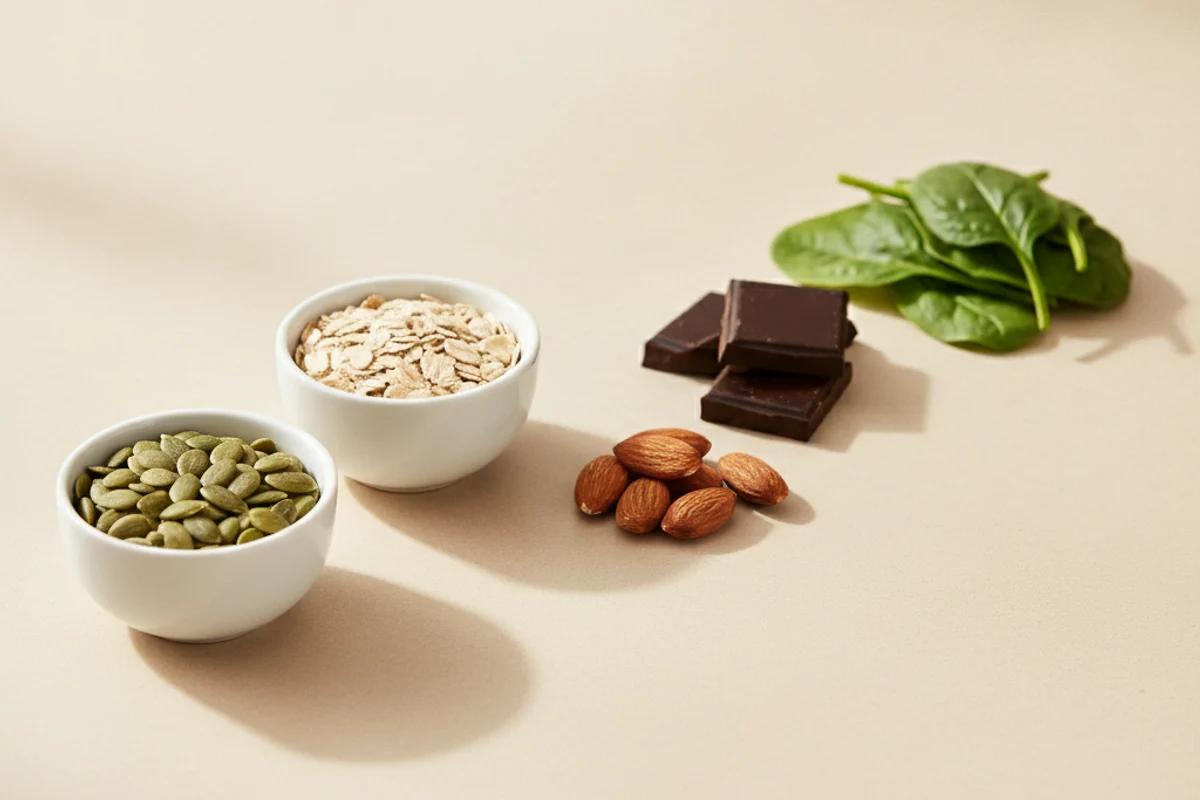
Magnesium is one of the few nutrients where a normal mixed diet usually gets an adult to the reference value without any product at all. Pumpkin seeds, oats, wholegrain bread and pasta, legumes, nuts, dark chocolate and leafy greens are dense enough that a few of them a day cover it.
What training changes is not the target — no authority sets a higher magnesium requirement for athletes — but the chance of missing it. More sweat, more food volume passing through, and, if you are eating in a deficit, less room on the plate for exactly the foods that carry magnesium. That is the situation in which a supplement earns its place: closing a measurable gap, at 100–250 mg, rather than topping up a target you were already meeting. Whether the gap is real is a question a week of honest logging answers better than a guess — that is what the nutrition tracker is for.
If you want the rest of the shelf in the same frame — what is worth buying, what is worth skipping, and what belongs behind a blood test — the sports supplement guide works through it item by item, and the Swiss creatine comparison runs this same price arithmetic on creatine.
Frequently asked questions
Which magnesium is cheapest in Switzerland?
At the prices checked on 11 September 2026, ProFuel Magnesium Komplex is cheapest per milligram at about CHF 0.06 per 100 mg of elemental magnesium, followed by Lee-Sport Magnesium Citrat powder at about CHF 0.07. Measured per day instead, GN Magnesium Citrate is cheapest at about 16 rappen — but only because its portion is 150 mg, the smallest in the comparison. Add shipping if you order a single pack.
What does “elemental magnesium” mean on a label?
It is the amount of magnesium itself, as opposed to the weight of the salt carrying it. Tri-magnesium citrate is roughly 12–16% magnesium, bisglycinate around 10–14%, oxide about 60% — so "2100 mg magnesium citrate" and "336 mg magnesium" can describe exactly the same three capsules. The nutrition table is where the elemental figure lives, and it is the only number worth comparing between products.
Is magnesium bisglycinate better than citrate or oxide?
Organic forms such as citrate and bisglycinate dissolve better than magnesium oxide and are generally better absorbed, so the form is not irrelevant. But no form is automatically right for everyone, oxide is not worthless, and a blend of several compounds is a formulation choice rather than evidence of a bigger effect. Individual tolerance matters more than the hierarchy, and it is not something a product page can tell you.
How much magnesium should I take a day?
The reference value for adults is 300–350 mg of total magnesium per day, food included, and training does not raise it. If food leaves a gap, 100–250 mg a day from a supplement closes it; 250 mg a day from supplements is the tolerable upper level set by the EU Scientific Committee on Food. Several products in this comparison recommend a portion above that figure, which is why a high dose is not treated as a quality feature here.
The bottom line
- A five-and-a-half-fold price spread for the same mineral: CHF 0.06 to CHF 0.33 per 100 mg of elemental magnesium.
- Compare the elemental figure, never the compound weight on the front of the pack.
- Granularity beats headline dose. A 100 mg capsule can become 300 mg; a 375 mg capsule cannot become 200 mg.
- The cheapest product is not the winner, because its own recommended portion is 400 mg — 150 mg above the EU upper level for supplemental magnesium.
Sources
- FSVO: nutrient reference values for SwitzerlandThe Swiss reference values, which follow the D-A-CH figures of 300–350 mg per day for adults.
- EFSA (2015): Scientific opinion on dietary reference values for magnesium, EFSA Journal 13(7):4186The adequate intake of 350 mg for men and 300 mg for women.
- EU Scientific Committee on Food (2001): opinion on the tolerable upper intake level of magnesiumThe 250 mg per day upper level for magnesium from supplements, on top of food.
- NIH Office of Dietary Supplements: Magnesium — Health Professional Fact SheetAbsorption by compound, food sources, side effects and the interactions with medication.
- FSVO: nutrition and health claimsThe Swiss legal basis for which magnesium claims a product may carry, and under which conditions.
Price check and method. Prices, pack sizes, nutrition tables, ingredient lists and stock were read from the shops' own product pages on 11 September 2026: whey-protein.ch (Lee-Sport), sponser.ch, unisupps.com (ESN, GN Laboratories, Peak, ProFuel, Vitaminotheke) and nu3.ch (Burgerstein, Pure Encapsulations). Price per 100 mg of elemental magnesium and cost per day are our own calculations from the pack price, the unit count and the declared elemental amount; shipping is quoted from each shop's own terms and is not included in those figures. Two of the prices read were reduced against a crossed-out reference price on the check date — Burgerstein Magnesiumvital at CHF 28.50 against CHF 35.00, and Burgerstein's shelf price at another Swiss retailer was CHF 29.90 the same day — so the figure used is the one actually charged, and a promotion can move it. Manufacturer statements, independent proof and editorial assessment are kept apart throughout: where a claim comes from the maker it is attributed, and where no public proof exists it is called not publicly documented rather than treated as a defect. This comparison is limited to the products, criteria and date named above, and "best" never means more than that. No laboratory analysis of our own was performed, no product samples were supplied, there is no paid cooperation and there are no affiliate links. All images are generated by us and show no branded packaging. This page is reviewed again at the latest six months after the date above, or sooner if prices move.
General information only: This article is general nutrition information and not medical advice. Magnesium can interact with medication, and high intakes are a genuine consideration with impaired kidney function. If you have a kidney condition, are pregnant or breastfeeding, take regular medication or are under 18, discuss magnesium with an appropriate healthcare professional before using it.