Creatine monohydrate is not a complicated product. It is a single molecule, and two powders that really consist of pure monohydrate deliver the same thing to your muscle. That makes it one of the few supplements where the shelf price says almost everything — and where paying more buys documentation and convenience, not effect.
Checked on 11 September 2026, the spread between the cheapest and the most expensive pure monohydrate powder you can order in Switzerland is two and a half times: from about CHF 0.20 to about CHF 0.50 for the same 5 g daily dose.
The short answer: For an everyday 3–5 g dose, Lee-Sport Creatin Monohydrat in the 1 kg bag is the best combination here — Creapure raw material, one ingredient, about CHF 0.20 per 5 g portion. If you want it as cheap as possible and do not need a named raw material, MyProtein Kreatin Monohydrat (unflavoured, 1 kg) costs the same per portion. Sponser and Olimp document just as well and cost roughly twice as much per portion.
How these products were selected
There is no public statistic for the Swiss creatine market, so the selection is stated rather than implied. Everything below is a pure creatine monohydrate powder that could be ordered to a Swiss address on the check date, with a Swiss franc price and a published ingredient list. Three channels were checked:
- Swiss brand shops — Lee-Sport (whey-protein.ch) and Sponser, both of which publish their ingredient declaration and their raw material on the product page.
- An international brand's Swiss shop — MyProtein's Swiss store, where the price is quoted in francs for a Swiss delivery.
- A Swiss multi-brand supplement retailer — Unisupps, which ships from a Swiss warehouse and carries Optimum Nutrition, Olimp, Scitec, BioTechUSA and ESN.
Three products that are listed in Switzerland were left out because they were out of stock on the check date: ESN Ultrapure creatine powder (500 g, CHF 36.90), Scitec 100% Creatine Monohydrate (300 g, CHF 19.90) and BioTechUSA 100% Creatine Monohydrate (300 g, CHF 32.90). They are named here so their absence reads as a stock check rather than a verdict.
Capsules, gummies, effervescent sticks and flavoured creatine blends are not in the main ranking at all. They are a different product with a different price per gram, and mixing them in would quietly make the ranking meaningless — there is a separate section for them below.
The scale, published before the ranking
The overall grade uses the Swiss 1–6 scale and is composed of four criteria. The weights are fixed for every product:
| Criterion | Weight | What earns a high grade |
|---|---|---|
| Raw material and origin | 20% | The raw material is named, its manufacturer and country stated, and individual batches are publicly verifiable |
| Independent testing | 20% | A publicly documented third-party or accredited-laboratory test, judged by what it actually covers |
| Declaration and purity | 20% | One ingredient, no fillers, flavours or sweeteners, and a stated daily dose |
| Value for money | 40% | Price per 5 g portion at the cheapest regularly available pack, shipping stated separately |
Value for money is graded from the price per 5 g portion: 6 up to CHF 0.22, 5 up to 0.30, 4 up to 0.40, 3 up to 0.50, 2 up to 0.65, 1 above that. No own laboratory analysis was carried out. A missing proof is recorded as "not publicly documented" — which is a statement about the documentation, not about the product's quality.
The 1–6 scale used here
- 5.5+Outstanding
- 4.5+Very good
- 3.5+Good
- 2.5+Adequate
- 1.5+Weak
- 1.0+Poor
The ranking
Six pure creatine monohydrate powders orderable in Switzerland, checked 11 September 2026. The grade combines documentation (60%) with price per portion (40%).
- 1.Lee-Sport Creatin Monohydrat (Creapure), 1 kgCHF 0.20 / 5 gOverall grade: 5.6Outstanding
The only product that is both the cheapest per portion and fully documented: Creapure from AlzChem Trostberg, one ingredient, produced for a Swiss brand. The 1 kg bag no longer ships with a scoop.
- 2.UNISUPPS Creatine Pure, 500 gCHF 0.27 / 5 gOverall grade: 4.6Very good
A very clean declaration — one ingredient, no flavour, sweetener, colour or filler — and a stated production country. The raw material itself is not named, so the documentation stops one step short.
- 3.MyProtein Kreatin Monohydrat, unflavoured, 1 kgCHF 0.20 / 5 gOverall grade: 4.4Good
The joint-cheapest portion price. It gets there on price alone: neither the raw material, its manufacturer nor the production country is stated, and no public test is documented.
- 4.Sponser Creatine Monohydrate, 500 gCHF 0.42 / 5 gOverall grade: 4.4Good
100% Creapure, one ingredient, developed in Switzerland and produced in Germany. The documentation is as good as it gets here — you pay roughly double per portion for it.
- 5.Olimp Creapure Powder, 500 gCHF 0.50 / 5 gOverall grade: 4.4Good
Also 100% Creapure with the manufacturer named, vegan and free of sweeteners. The most expensive portion in this comparison, which is what pulls the grade down.
- 6.Optimum Nutrition Micronised Creatine Powder, 317 gCHF 0.47 / 5 gOverall grade: 3.2Adequate
A clean 100% micronised monohydrate with nothing wrong with it — but nothing publicly documented beyond the label either, at more than twice the portion price of the cheapest option.
Three products land on the same 4.4 by three different routes, and that is the most useful thing in the table: MyProtein gets there on price with no documentation, Sponser and Olimp on documentation at double the price. Which of those you prefer is a decision the grade cannot make for you.
What 5 g actually costs
The calculation behind every row is the same: pack price ÷ pack weight × 5. Shipping is listed separately because it changes the answer for a single tub, and because the thresholds differ per shop.
Regular prices, checked 11 September 2026.
| Product | Pack | Price | CHF / 100 g | CHF / 5 g | Shop, shipping |
|---|---|---|---|---|---|
| Lee-Sport Creatin Monohydrat | 1000 g | CHF 39.90 | 3.99 | 0.20 | whey-protein.ch, CHF 5.90 (free from 59) |
| MyProtein Kreatin Monohydrat | 1000 g | CHF 40.90 | 4.09 | 0.20 | myprotein.ch, free from CHF 70 |
| MyProtein Kreatin Monohydrat | 500 g | CHF 25.90 | 5.18 | 0.26 | myprotein.ch |
| UNISUPPS Creatine Pure | 500 g | CHF 26.90 | 5.38 | 0.27 | unisupps.com, CHF 7.90 (free from 80) |
| Lee-Sport Creatin Monohydrat | 350 g | CHF 19.90 | 5.69 | 0.28 | whey-protein.ch |
| Sponser Creatine Monohydrate | 500 g | CHF 42.00 | 8.40 | 0.42 | sponser.ch, CHF 9.90 (free from 100) |
| Optimum Nutrition Micronised | 317 g | CHF 29.90 | 9.43 | 0.47 | unisupps.com |
| Olimp Creapure Powder | 500 g | CHF 49.90 | 9.98 | 0.50 | unisupps.com |
One caveat worth doing the arithmetic on: buying a single tub below a shop's free-shipping threshold moves the ranking. A Lee-Sport 1 kg bag on its own is CHF 45.80 delivered, or about CHF 0.23 per portion; a single Unisupps tub is CHF 34.80 delivered, or about CHF 0.35. Creatine keeps for years in a dry cupboard, so the big bag is usually the cheaper decision twice over.
MyProtein needs one more note. Its creatine is permanently shown against a much higher reference price — CHF 62.90 for the 1 kg — that nobody appears to pay. The figure in the table is the price actually charged on the check date, not the crossed-out one.
Creatine supports a diet and a plan. It does not replace either.
Creatine works on repeated hard efforts — so it only pays off if you are producing them and eating enough to recover from them. Set your goal in GetMyCoach and get your daily calorie and protein target free, no training plan required.
What Creapure proves — and what it does not
Creapure is the brand name of the creatine monohydrate made by AlzChem Trostberg GmbH in Trostberg, Germany. AlzChem states at least 99.9% purity, an undetectable level of dihydrotriazine and dicyandiamide far below the EFSA limits, and a batch number you can look up on its own site. The raw material is also tested regularly for the Cologne List, a German programme that screens supplements for anabolic steroids and stimulants.
That is real documentation, and it is why every Creapure product here scores a 6 on raw material. But read the scope precisely, because the marketing rarely does:
- The Cologne List test and the certificate of analysis cover the raw material, not each brand's finished, filled and sealed pack. Filling and packing happen somewhere else.
- A raw material with a name is a traceability advantage, not proof that an unnamed monohydrate is contaminated. It is a proof that exists versus a proof that does not.
- Nothing about Creapure makes it work better in your muscle than a clean generic monohydrate at the same dose. None of the products here claims otherwise, and neither do we.
That is also why Creapure alone does not win this comparison: Sponser and Olimp document exactly as well as Lee-Sport and still finish lower, because they cost roughly twice as much for the same daily gram.
Capsules, gummies and blends
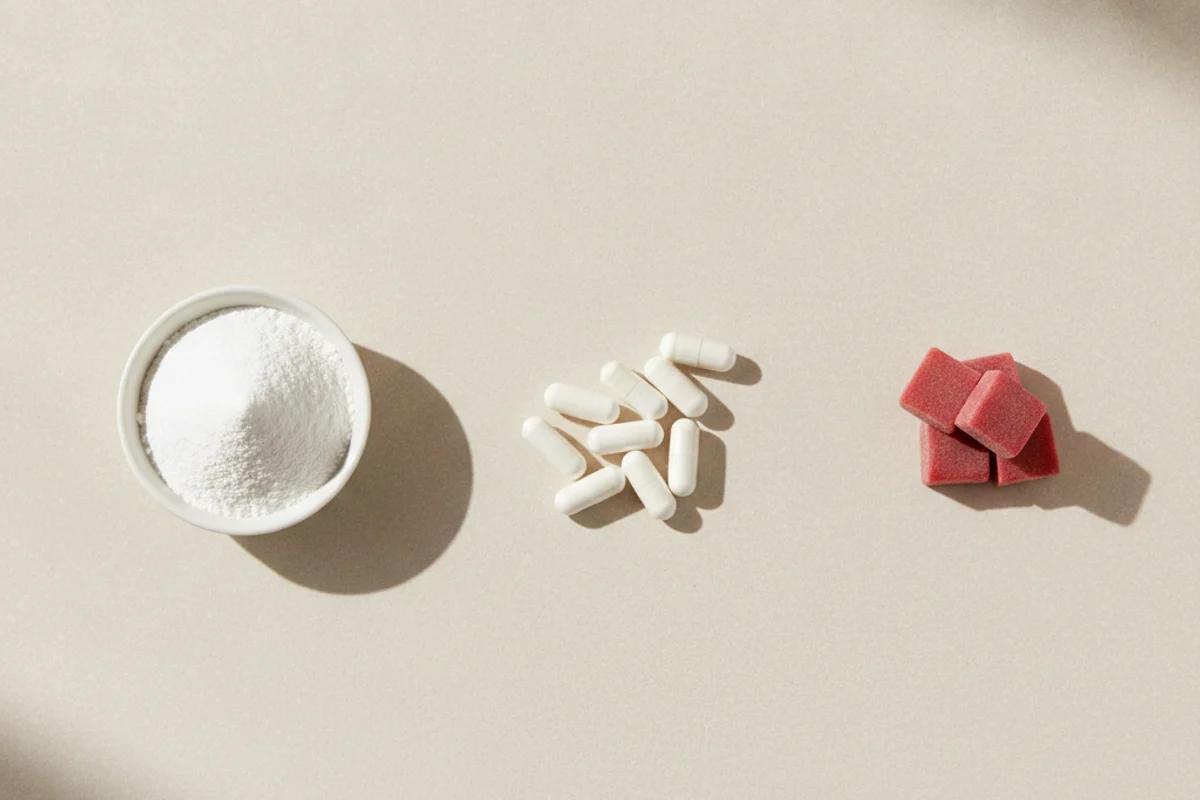
The same 3 g of creatine comes in several formats, and the format is what you pay for. At Swiss prices on the check date:
- Capsules — around CHF 17.90 for 90 capsules, or CHF 44.90 for 300. Convenient for travel, and you swallow four to six a day to reach the dose. Per gram of creatine they cost several times the powder.
- Gummies — around CHF 11.90 for 28. Pleasant, and by far the most expensive way to buy creatine. Check the label for how many gummies make 3 g; it is often more than the packaging implies.
- Effervescent sticks — around CHF 12.90 for 30 × 4 g. Portioned and flavoured, again at a large premium per gram.
- Flavoured creatine blends and "creatine plus" mixes — these contain carbohydrates, flavours, sweeteners and sometimes other actives, so the price per gram of creatine is not comparable with a plain monohydrate. Read the per-serving creatine figure, not the tub size.
- Other creatine forms — creatine hydrochloride, kre-alkalyn, tri-creatine malate. They are sold on the claim of better absorption or no water retention. Monohydrate is the form the evidence base and the approved health claim are built on; the review literature does not put the alternatives ahead of it.
What creatine does, and how to take it
In Switzerland the only health claim a creatine product may carry is set out in Annex 14 of the federal Food Information Ordinance (LIV): creatine increases physical performance in successive bursts of short-term, high-intensity exercise. The claim is tied to a condition — 3 g of creatine per day — and to a target group of adults doing intense exercise. It says nothing about disease, and neither does this article.
Beyond that claim, the practical picture from the position stand of the International Society of Sports Nutrition and the review that followed it is unusually settled:
- A loading phase is optional. Twenty grams a day for five to seven days fills the muscle faster; 3–5 g a day fills it too, just over a few weeks.
- 3–5 g a day, every day is the maintenance dose, on training days and rest days alike. Timing barely matters; consistency does.
- In healthy adults it has no demonstrated harm to kidney function at these doses. Blood creatinine can read slightly higher without kidney function having changed — that is where the myth comes from. With existing kidney disease, in pregnancy, or alongside medication, ask a doctor first.
- Some weight gain is water inside the muscle cell, typically one to two kilos in the first weeks. That is the mechanism working, not fat.
For how the dose changes between strength training, HYROX and running, we have a separate guide to creatine dosage by sport. And if you are deciding what deserves a place in your supplement budget at all, start with the supplements that actually work — or with the Swiss protein powder comparison, which runs the same price arithmetic on whey.
Frequently asked questions
Which creatine is cheapest in Switzerland?
At the prices checked on 11 September 2026, two products share the lead at about CHF 0.20 per 5 g portion: Lee-Sport Creatin Monohydrat in the 1 kg bag at CHF 39.90, and MyProtein Kreatin Monohydrat unflavoured in the 1 kg bag at CHF 40.90. The difference is documentation rather than price — Lee-Sport names Creapure as its raw material, MyProtein names none. Add shipping if you order a single pack.
Is Creapure worth the extra money?
It buys traceability, not a stronger effect. Creapure is creatine monohydrate from AlzChem in Germany with at least 99.9% stated purity, publicly verifiable batches and regular Cologne List testing of the raw material — genuinely useful if you are drug-tested in competition. It does not make the same daily gram work better in your muscle, and the Creapure products in this comparison range from the cheapest portion price here to the most expensive.
How much creatine should I take per day?
Three to five grams a day, every day, including rest days. That is also the amount the approved Swiss health claim is tied to: 3 g per day. A loading phase of about 20 g a day for five to seven days fills the muscle faster but is not necessary — a maintenance dose gets to the same place within a few weeks.
Are creatine capsules or gummies better than powder?
Not for effect — only for convenience. The same molecule in a capsule or a gummy costs several times as much per gram of creatine, and you need four to six capsules to reach a daily dose. If a format is the reason you actually take it every day, that is a fair trade; otherwise the powder is the same product for a fraction of the money.
The bottom line
- One dose, a two-and-a-half-fold price spread: CHF 0.20 to CHF 0.50 for the same 5 g.
- The big bag wins twice — lower price per gram, and it clears the free-shipping threshold.
- Creapure documents the raw material, not each finished pack, and it is not a performance claim.
- Everything that is not plain monohydrate powder — capsules, gummies, sticks, blends — is the same molecule at a convenience premium.
Sources
- FSVO: Nutrition and health claims (Food Information Ordinance, LIV, Annex 14)The Swiss legal basis for the permitted creatine claim and its 3 g per day condition.
- EFSA (2011): Scientific Opinion on creatine and physical performance, EFSA Journal 9(7):2303The scientific assessment the approved claim is based on.
- Kreider RB et al. (2017): ISSN position stand — safety and efficacy of creatine supplementation, JISSN 14:18Dosing, loading, and the safety evidence in healthy adults.
- Antonio J et al. (2021): Common questions and misconceptions about creatine supplementation, JISSN 18:13Kidney function, water retention, and why other creatine forms do not beat monohydrate.
- Creapure (AlzChem Trostberg GmbH): quality and manufacturingStated purity, by-product limits, batch verification and Cologne List testing of the raw material.
Price check and method. Prices, pack sizes, ingredient lists and stock were read from the shops' own product pages on 11 September 2026: whey-protein.ch (Lee-Sport), sponser.ch, myprotein.ch and unisupps.com (UNISUPPS, Optimum Nutrition, Olimp). Price per 100 g and per 5 g portion are our own calculations from the pack price and weight; shipping is quoted from each shop's own terms and is not included in those figures. Manufacturer statements and editorial assessment are kept apart throughout: where a claim comes from the maker it is attributed, and where no public proof exists it is called not publicly documented rather than treated as a defect. This comparison is limited to the products, criteria and date named above, and "best" never means more than that. No laboratory analysis of our own was performed, no product samples were supplied, there is no paid cooperation and there are no affiliate links. All images are generated by us and show no branded packaging. This page is reviewed again at the latest six months after the date above, or sooner if prices move.
General information only: This article is general nutrition information and not medical advice. If you have kidney disease, are pregnant or breastfeeding, take regular medication or are under 18, discuss creatine with an appropriate healthcare professional before using it.