Squash Fitness: The Off-Court Training That Wins Matches
The honest guide to squash fitness — the four off-court pillars (footwork, conditioning, leg & core stability, mobility), why squash needs its own kind of training, and how to fit two to three sessions around your court time.
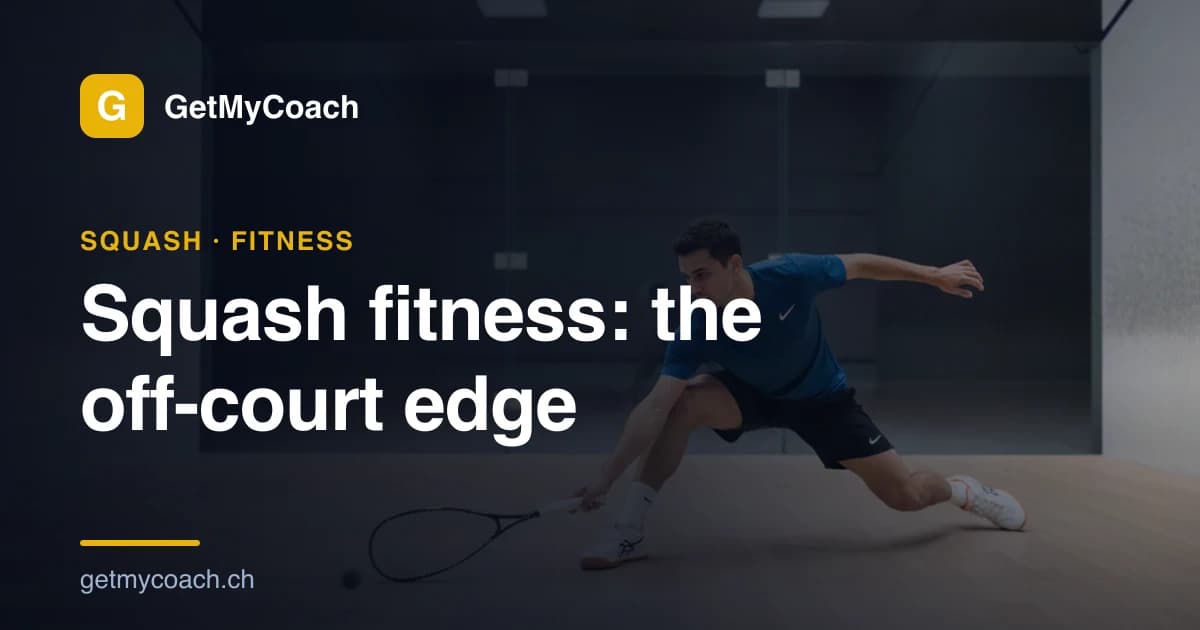
Squash is one of the most physically demanding sports there is. A hard match can have you covering a couple of kilometres of sprinting, hundreds of changes of direction and dozens of deep lunges — all inside a box barely bigger than a parking space. Yet most club players train only one thing: hitting the ball on court. The players who pull away are the ones who also train the engine that carries them to it.
This is the honest guide to squash fitness — the off-court training that makes you faster to the ball, steadier in the corners, and still moving well when a match goes long. It won't replace your time on court. It makes that time count.
The short version: Squash fitness rests on four pillars — footwork and agility, match endurance (conditioning), leg and core stability, and mobility. You don't need a gym membership or hours a week: two to three focused off-court sessions cover all four. The goal isn't to look like a runner or a lifter — it's to still move like a squash player deep into the fifth game.
Why squash needs its own kind of fitness
Squash is not a steady run, and training it like one is the most common mistake club players make. A rally is a burst — a few seconds of explosive sprinting, braking and lunging — followed by a short pause, repeated for an hour or more. That pattern taxes three things at once: your ability to produce force fast, your ability to repeat that effort without fading, and your ability to recover in the seconds between points.
Jogging steadily for 40 minutes trains almost none of that well. Squash-specific fitness is about repeatable explosiveness — being as sharp on the last point of the fifth game as on the first point of the first. That takes a different kind of training, built around the real demands of the court.
The four pillars of squash fitness
1. Footwork & agility
Everything in squash starts from the feet. Getting to the ball early — with balance to spare — is what lets you hit a good shot instead of a desperate one. That means a sharp split-step, quick first steps to the four corners, clean deceleration, and efficient movement back to the T. Footwork is the single highest-leverage thing most players can improve off court. → Squash footwork training: drills for faster feet.
2. Match endurance (conditioning)
This is what stops you fading in the back half of a match. Squash conditioning isn't long slow cardio — it's interval work that mirrors the rally: hard bursts with short recovery, trained until you recover faster between them and hold your speed longer. → Squash conditioning: how to improve your match endurance.
3. Leg & core stability
Deep lunges into the corners, hard braking and fast changes of direction all load your legs, hips and trunk under stress. Off-court strength — squats, lunges, hip hinges and anti-rotation core work — isn't about looking like a lifter. It's the stability that keeps your lunges deep and controlled late in a match, and it's your best protection against the knee, ankle and back injuries squash is known for.
4. Mobility
Squash asks your hips, ankles and thoracic spine for big, repeated ranges of motion under load. A little regular mobility work keeps those joints healthy and moving freely — so you can get low into the corners without paying for it the next day. It's the least glamorous pillar and the one that keeps you on court for years.
You don't need to live in the gym
Here's the reassuring part: covering all four pillars takes two to three off-court sessions a week, 25–45 minutes each — on top of, not instead of, your actual squash. A realistic week might look like:
- One agility & footwork session — split-step, court-movement drills and change of direction.
- One conditioning session — court intervals or ghosting bursts that mirror long rallies.
- One stability session — legs, hips and core, with mobility built into the warm-up and cool-down.
Play squash on your other days, keep one day genuinely easy, and that's a complete, sustainable week. If you can only manage two off-court sessions, combine stability and mobility into one and keep the conditioning session — never drop the engine work.
It complements court training — it doesn't replace it
None of this is a substitute for hitting balls, drilling and playing matches. Technique, racket skills and tactics are still won on court. Off-court fitness is the layer underneath: it means that when you are on court, you get to the ball earlier, hit from a balanced base, and are still doing it when your opponent is blowing. GetMyCoach doesn't replace your squash training — it makes you fitter, faster and more stable for it.
The bottom line
Squash fitness isn't one thing you can jog your way to. It's four pillars — footwork, conditioning, stability and mobility — each trained the way the sport actually moves: short, sharp, repeatable. Handle those off court, and your on-court game gets a level it can't reach through match play alone.
That's exactly what GetMyCoach builds: an off-court squash plan matched to your goal, your level and how many days you can train — footwork, conditioning and stability programmed and progressed for you, with a video demo on every drill, so you show up fitter for the court.
Get my squash plan → · or see how a plan is built on the squash training plan page.
Frequently asked questions
What fitness do you need for squash? Four things: quick, balanced footwork; match endurance (the ability to repeat hard efforts without fading); leg and core stability for lunging and braking; and mobility to move freely into the corners. Steady long-distance cardio trains almost none of these well — squash fitness is short, sharp and repeatable.
How many days a week should I train off court for squash? Two to three focused off-court sessions a week — agility, conditioning and stability — is plenty for most club players, on top of playing squash. Keep at least one genuinely easy day. Consistency over months matters far more than squeezing in extra sessions.
Does off-court training replace playing squash? No. Technique, racket skills and tactics are trained on court. Off-court fitness is the layer underneath that lets you use them — reaching the ball earlier, hitting from a stable base, and holding your level deep into a match.
Can I train squash fitness at home without a gym? Yes. Footwork drills, ghosting, sprints and bodyweight lunges and core work need almost no equipment. A few dumbbells or bands add options for the stability work, but you can build real squash fitness at home or on court.
Last updated: July 2026. General educational information, not medical advice. If you have a health condition or an injury, or haven't trained in a while, check with a doctor before starting a new program.