Protein Bars & Drinks in Switzerland: Smart Snack or Just Marketing?
Migros, Coop, Aldi, Lidl and Denner under the lens: which protein bars and drinks are actually worth buying? Protein, sugar, calories, protein quality and price, explained simply.
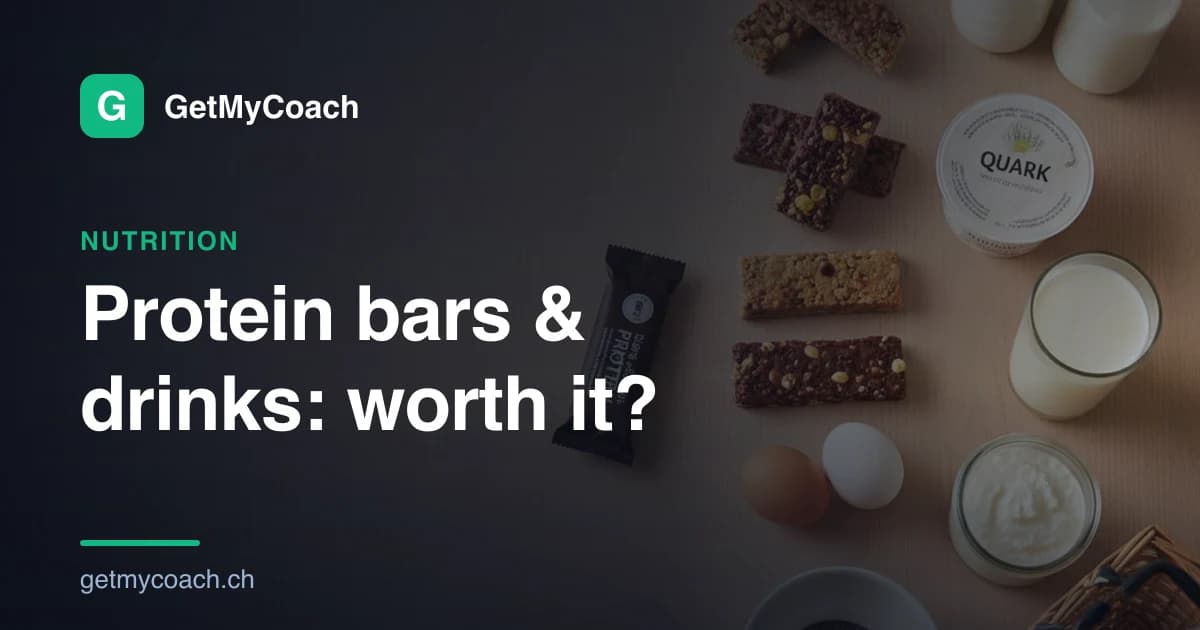
You'll find high-protein products in plenty of Swiss supermarkets now: Migros and Coop carry a broad range, Aldi and Lidl often have cheaper own-brand versions, and Denner tends to stock individual products or promotions — plus the big-name brands. A lot of it looks healthy — sleek packaging, a big number, "High Protein" in bold. But by our criteria, some of it is closer to a sweet snack with a protein label than a genuinely strong protein source.
This article is an editorial buying guide. There is no paid cooperation with the named brands unless explicitly stated. We look at protein bars and protein drinks from Swiss supermarkets by the same criteria: protein, sugar, calories, protein quality, price and how well they fit real life. By the end you should be able to decide in ten seconds in the shop whether a product is worth it — or whether you're only buying it for the label.
The short version: Protein bars and drinks aren't automatically healthy. They're worth it when they solve a real problem — too little protein during the day, no good meal while you're out, or a better snack than chocolate. They're not worth it when they're simply eaten on top of everything else and end up just adding calories.
When protein products are worth it
High-protein products have a real place. They're useful mainly when they fill a gap your normal meals aren't filling right now:
- When you struggle to hit your protein. Some people just don't reach their protein over the day — no appetite in the morning, lunch out, no time in the evening. A drink or bar is an easy, planned portion.
- After training. When the next real meal is still hours away, a protein drink is a convenient way to get protein in.
- On the go. On the train, on site, between two meetings — a bar lives in your bag and needs no fridge.
- As a snack swap. Instead of a chocolate bar, a croissant or chips, a protein bar with the same calories but 15–20 g of protein is often the better choice — it keeps many people fuller and gives you something usable.
- On a diet. If a product helps you stay fuller between two meals, it can be handy during a lower-calorie phase.
- For muscle building. If your daily protein otherwise doesn't add up from normal food, an extra portion is an honest top-up — for roughly how much protein you need, see our guide to eating for muscle growth.
In all of these, the product is a tool that replaces something worse or fills a genuine gap. That's exactly when a protein bar is worth it.
When they're not worth it
Just as honestly: often they aren't. Protein products become a problem when they come on top of everything else.
- When they're simply added. You eat normally and add two bars "because they're healthy" — that's just more calories, and your protein needs haven't changed.
- When the bar is basically a chocolate bar. Some products are high in fat, high in sugar and relatively low in protein. Then the gap to a sweet is small, but the price is double.
- When the ratio is off. Lots of calories, little protein — the classic "just marketing" product (see the criteria below).
- When you're buying the image. "High Protein" on the front doesn't make a food good. The label is marketing; the nutrition table is the truth.
- When normal food fits better. Quark, skyr, eggs, chicken, tofu or cottage cheese deliver the same or more protein, usually keep you fuller, and cost less. A bar replaces an emergency, not a meal.
Protein bar or protein drink — which is better?
Both have a role, but not the same one.
- Milk-based protein drinks are usually the better choice for pure protein supply. They deliver a lot of protein from high-quality milk protein, are filling, and skip the fat and sugar carriers a bar needs to hold together. A Migros or Coop protein drink often brings 30–35 g of protein per bottle.
- Protein bars are more of a practical snack swap. Their strength is convenience: shelf-stable, portable, no fridge needed. As a better alternative to chocolate when you're out, they're strong — as your main protein source, less so.
The simple rule of thumb:
- Is it specifically about protein? A protein drink, skyr or quark is almost always the better and cheaper solution.
- Would you otherwise grab chocolate on the go? Then a protein bar is the smarter pick.
What to check in the supermarket
You don't need an app to size up a product — three quick looks at the back are enough. Here's how we rate:
Good choice when:
- at least 15–20 g of protein per portion
- roughly 150–250 kcal per portion
- ideally under 5 g of sugar per portion
- a high-quality protein source: milk protein, whey, casein, soy, pea protein or a protein blend
- filling
- a fair price
- well tolerated
Okay when:
- enough protein, but a bit pricey for it
- lots of sweeteners or polyols (fine for taste, not ideal as a daily fix)
- a few more calories than needed
- good as an occasional snack, not the first choice as an everyday solution
More marketing when:
- little protein relative to the portion
- lots of calories
- lots of fat or sugar
- a less-than-ideal protein source (e.g. mostly collagen)
- looks healthy, but by our criteria is closer to a dessert
Sugar, sweeteners and polyols
A low sugar figure on the front is a good sign — but not the whole picture.
- Low sugar doesn't automatically mean natural. Often the sugar has simply been replaced by sweeteners (e.g. sucralose) or polyols (sugar alcohols like maltitol, erythritol). That's not bad, but it's "engineered", not "natural".
- Calorie-wise it's often smart. That's exactly how a bar lands at 1–2 g of sugar and still tastes sweet.
- Your gut sometimes has an opinion. A lot of polyols at once can cause bloating or stomach discomfort in sensitive people. If that's you, ease into it.
- With milk drinks, tell two kinds of sugar apart. A protein drink often shows 12–16 g of sugar per bottle — that's mostly natural milk sugar (lactose), not added sugar. That's different from 16 g of added sugar in a bar.
- "No added sugar" isn't "sugar-free". It only means no sugar was added on top — the natural sugar from milk or fruit is still there.
Low sugar often doesn't mean the product is natural. Frequently the sugar was simply replaced by sweeteners or polyols.
Protein quality — not all protein is equal
This is where it gets interesting, because the big number on the front says nothing about where the protein comes from. For muscle building and satiety, the protein quality in a bar matters at least as much as the amount.
Very good protein sources:
- milk protein
- whey
- casein
- soy isolate
Good to okay protein sources:
- pea protein
- rice protein
- plant protein blends
Watch out for collagen: Many protein bars blend in collagen hydrolysate or gelatine, because it's cheap and lifts the protein number on the pack. Collagen isn't bad — but as a main protein source for muscle building it isn't equivalent to whey, milk protein or soy, because it's missing key amino acids. So if collagen or gelatine is high on the ingredient list, the "20 g protein" on the front is worth less than it looks.
That's also the most honest pattern from our supermarket check below: many bars combine milk or soy protein with collagen, while the drinks almost all use clean milk protein. For protein quality per franc, the drinks are often the more honest products.
Swiss supermarket check
Here's a comparison of typical products from Swiss supermarkets and well-known brands. Important: we don't invent nutrition values. Products with reliable, publicly verifiable figures are in the first two tables; products where we couldn't find clean values online are listed separately under "Check in the shop". The discounters (Aldi, Lidl, Denner) rarely publish nutrition tables online — so they end up there more often. Unless otherwise noted, all values are manufacturer or shop figures, or taken from the packaging, as of June 2026; recipes and nutrition values can change, so when in doubt check the current packaging.
How to read the tables:
- ~ = calculated onto the portion from the per-100 g or per-100 ml figure (not read straight off a per-portion label).
- n/a = not reliably available publicly → check the packaging.
- † = contains collagen or gelatine (see the protein quality section).
- "Good snack pick" = strong as a snack swap, but only okay for pure muscle building because of the collagen.
Protein bars with reliable data (per bar)
| Product (retailer) | Portion | Protein | kcal | Sugar | Protein source | Price approx. | Rating |
|---|---|---|---|---|---|---|---|
| Barebells (Coop, Migros) | 55 g | 20 g | 194 | 1.3 g | Milk/soy protein + collagen † | CHF 3.40 | Good snack pick |
| Chiefs Protein Bar (Coop) | 55 g | 20 g | ~205 | 1.5–2.3 g | Milk/soy protein + collagen † | ~CHF 3.25 | Good snack pick |
| Chiefs Protein Soft Bar | 55 g | 16 g | ~202–226 | ~1.5 g | Milk/soy protein + collagen † | ~CHF 3.25 | Good snack pick |
| Chiefs Protein Core Bar | 40 g | 13 g | ~155 | ~1.7 g | Milk/soy protein + collagen † | n/a | Okay |
| Chiefs Protein Schnitte (Kägi × Chiefs) | 50 g | 13 g | 240 | 2.9 g | Whey/milk/wheat protein + collagen † | n/a | Okay |
| Sponser Low Carb Bar | 50 g | 14–15 g | ~170 | ~2 g | Milk protein | CHF 3.20 | Good choice |
| Migros M-Budget Protein Bar | 45 g | ~16 g | 189 | 2.2 g | Milk protein + gelatine, soy † | CHF 1.50 | Okay |
| Lidl Protein Bar | 45 g | ~15 g | ~176 | ~1.3 g | Soy, milk protein + collagen † | n/a | Okay |
Protein drinks with reliable data (per bottle, unless stated otherwise)
| Product (retailer) | Portion | Protein | kcal | Sugar | Protein source | Price approx. | Rating |
|---|---|---|---|---|---|---|---|
| Emmi Energy Milk High Protein | 330 ml | ~26 g | ~205 | ~16 g* | Milk protein | n/a | Good choice |
| Emmi Energy Milk High Protein Double Zero | 330 ml | ~26 g | ~208 | ~15 g* | Milk protein | n/a | Good choice |
| Chiefs Milk Protein Drink (Coop) | 330 ml | ~26 g | ~160–190 | ~9 g* | Milk protein (lactose-free) | ~CHF 3.80 | Good choice |
| Coop High Protein Drink Vanilla | 500 ml | ~40 g | ~280 | ~14 g* | Milk protein / skimmed milk | n/a | Good choice |
| Coop High Protein Drink Choco | 500 ml | ~40 g | ~290 | ~14 g* | Milk protein / skimmed milk | n/a | Good choice |
| Coop High Protein Drink Strawberry | 500 ml | ~35 g | ~260 | ~13 g* | Milk protein / skimmed milk | n/a | Good choice |
| Coop High Protein Drink Choco-Nuts | 500 ml | ~35 g | ~300 | 0 g | Soy protein isolate | n/a | Good choice |
| Migros Oh! High Protein Drink | 500 ml | ~35 g | ~245 | ~25 g | Milk protein (lactose-free) | n/a | Okay |
| Aldi Milsani High Protein Drink | 330 ml | ~35 g | ~214 | ~17 g* | Milk protein / skimmed milk | CHF 1.35 | Good choice |
| Denner High Protein Milk | 1 l | 7 g / 100 ml | 39 / 100 ml | 2.5 g / 100 ml | Milk protein | n/a | Good choice |
| YFood "This is Food" | 500 ml | 34 g | 500 | 22 g | Milk protein | CHF 5.45 | Special case |
* In milk drinks the sugar is mostly natural milk sugar (lactose), not added sugar. "Double Zero" means no added sugar.
Check in the shop (nutrition values not reliably available online)
For these products we couldn't find a reliable, public nutrition figure — give the back of the pack a quick check (protein, sugar, source):
| Product (retailer) | Portion | Protein source (from ingredients) | Price approx. |
|---|---|---|---|
| Coop High Protein Bar Choco | 40 g | Casein/whey, soy + collagen † | CHF 1.40 |
| Aldi MULTINORM Protein Bar | 45 g | Soy protein | CHF 1.49 |
| Denner enerBiO Protein Bar | 3 × 25 g | n/a | CHF 2.45 (3-pack) |
| Lidl protein drink | n/a | n/a | n/a |
The 10-second rule in the shop
How to decide right at the shelf, without doing maths:
- Does the bar have at least 15 g of protein?
- Is it under roughly 220 kcal?
- Is the sugar low?
- Is the protein source milk protein, whey, casein, soy or pea protein (not mostly collagen)?
- Am I eating it instead of chocolate – or on top?
If you can say yes four times, the product is usually a sensible pick.
A short note per product (our view, based on the nutrition values):
- Barebells: A lot of protein, very little sugar — excellent as a snack swap. The protein blend contains collagen, so the number flatters it slightly for pure muscle building.
- Chiefs (three lines): The Protein Bar (20 g; e.g. Double Choc, Crispy Cookie, Salty Caramel, White Mocha, Strawberry, Birthday Cake, Fudge Brownie) carries the most protein. The softer Protein Soft Bar (16 g; Choco Coco, Peanut Caramel, Choco Caramel) and the smaller Protein Core Bar (40 g, 13 g; Choco Pretzel, Peanut Butter, Vanilla Cheesecake) are more dessert-style snacks. All use a milk/soy/collagen blend — a good snack pick, but only okay for pure muscle building because of the collagen. The Protein Schnitte (Kägi × Chiefs, 50 g, 13 g) is a Swiss-made wafer slice — tasty, but at 240 kcal more of a sweet snack than a protein source.
- Sponser Low Carb Bar: The only bar in the comparison without collagen — clean milk protein. A touch less protein, but the most honest source. (Two Swiss shops list 14 vs 15 g — check the pack.)
- Migros M-Budget Protein Bar: Cheap and solid for the price, but contains gelatine. Okay as an everyday snack, not as a main source.
- Lidl Protein Bar: A decent ratio, but also contains collagen alongside soy and milk protein.
- Emmi Energy Milk High Protein: Swiss milk protein, no collagen, very usable for protein supply. "Double Zero" has no added sugar.
- Chiefs Milk Protein Drink: ~26 g of protein per 330 ml bottle from lactose-free milk protein, no collagen — a convenient protein top-up (available at Coop).
- Coop & Migros protein drink: Coop offers several flavours (vanilla, choco, strawberry, choco-nuts) with ~35–40 g of protein per 500 ml bottle; the choco-nuts version uses soy protein isolate and has no sugar. The Migros Oh! sits noticeably higher on sugar, so keep an eye on that.
- Aldi Milsani drink: A lot of protein at a low price — one of the most attractive options on cost.
- Denner High Protein Milk: Clean milk protein, but it comes as a litre carton, not a single-serve bottle.
- YFood: A meal replacement, not a snack — around 500 kcal per bottle. Useful when it replaces a whole meal, not as an extra drink on the side.
My simple buying rule
When you're standing in the shop and don't want to overthink it, this checklist is enough.
A product is usually worth it when:
- it delivers at least 15 g of protein
- it doesn't carry needlessly many calories
- the sugar is low
- the protein source is high quality (milk protein, whey, casein, soy — not mostly collagen)
- it replaces a worse alternative (e.g. chocolate on the go)
- it's well tolerated
A product is usually not worth it when:
- it's eaten like a dessert
- it has little protein
- it delivers lots of calories
- it doesn't keep you full
- you're buying it only for the "High Protein" label
Which is best for which goal?
| Goal | Best choice |
|---|---|
| Muscle building | Protein drink, skyr, quark, normal protein-rich meals; bars only as a top-up |
| Losing weight | A bar only if it keeps you full and saves calories |
| On the go | Protein bar — practical and shelf-stable |
| After training | Protein drink usually better |
| Office snack | Protein bar beats chocolate, but isn't automatically healthy |
| Kids / teenagers | Prefer normal food |
The bottom line
Protein products can be worth it, but they're not miracle workers. Protein drinks are, in our view, often the better choice for targeted protein supply — lots of protein from clean milk protein, filling, fair on price. Protein bars are strongest as a practical snack swap, on the go and at the office. But the foundation stays normal food: quark, skyr, eggs, chicken, tofu, cottage cheese. And whatever the product: always glance at the nutrition values and the ingredient list rather than being dazzled by the high-protein label — especially for the protein quality in a bar.
Protein products are worth it when they help you hit your daily protein more easily or replace a worse snack. They're not worth it when they're simply eaten on top and only add calories.
So protein products can help — but what really decides things is your overall training and nutrition plan. With GetMyCoach you get a plan that thinks training and nutrition together: matched to your goal, your everyday life and your progress.
Last updated: June 2026. Products, recipes, prices and availability can change and vary by store and promotion. The figures are based on publicly available manufacturer/shop information or on the packaging at the time of research; values marked "~" are calculated up from per-100 g or per-100 ml figures. Despite careful checking, errors or changes can't be ruled out. This article is an editorial buying guide, not medical or nutritional-medicine advice. Brand and product names are mentioned only for context. There is no cooperation with the named brands unless explicitly stated. We're happy to receive notes about incorrect or outdated figures and will review them promptly.